By: Mordy Friedman
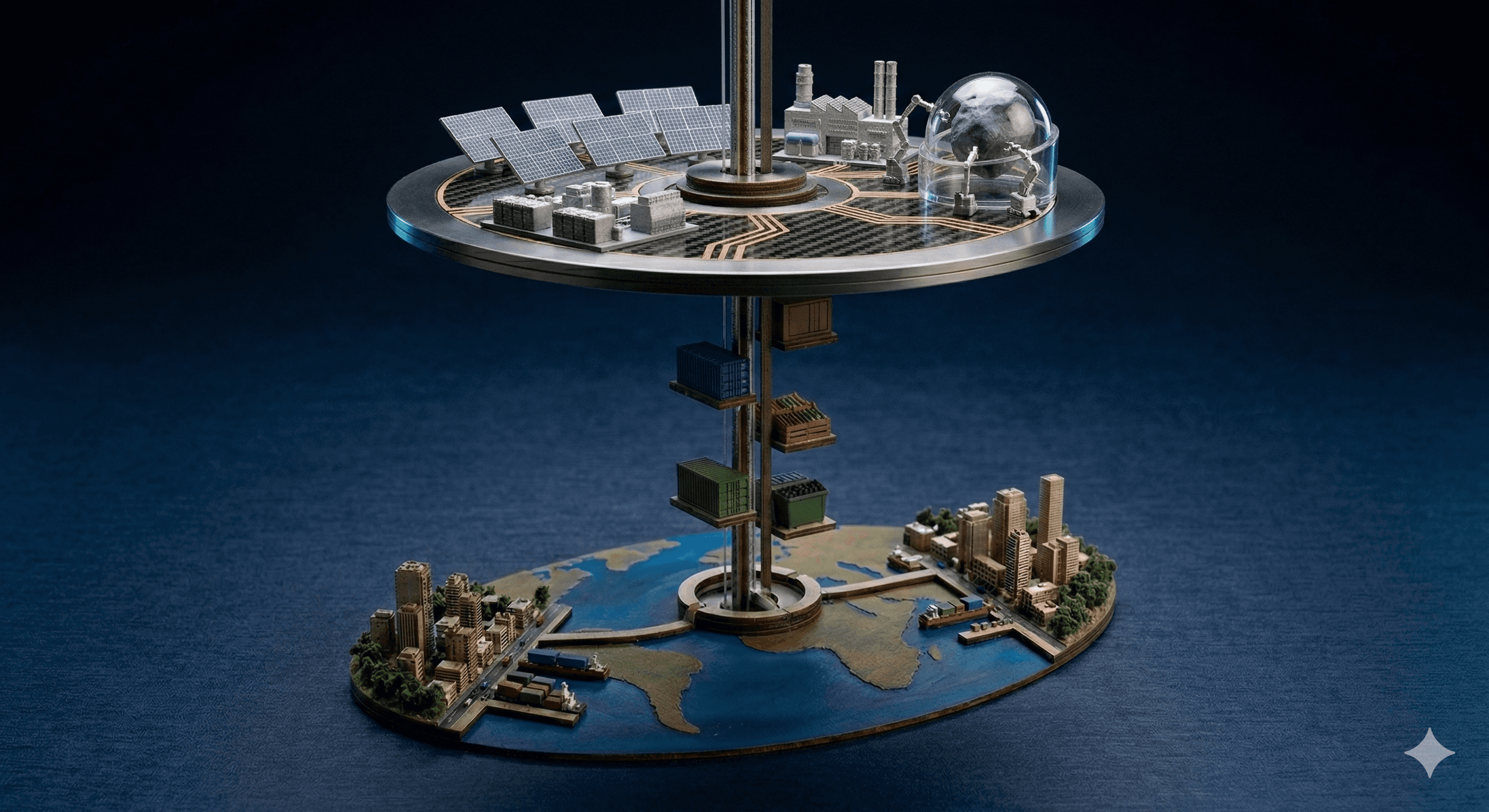
Scaling Earth: The Economics of an Abundant Future
A recent trip to Washington D.C. brought a very specific reality into focus. While having conversations across the capital, it became clear that the global perspective on the space industry remains incredibly narrow.
Policymakers and traditional markets continue to treat the cosmos as a niche sector, reserved almost exclusively for defense, data, and specialized research.
This localized perspective proves that a massive shift in our collective understanding is needed. We are still treating space like a specialized government program rather than the next logical expansion of human infrastructure. While there are certainly small signs of progress with this view, we must push the boundaries and accelerate this dialogue. We need the world to recognize the true scale of the industry we are unlocking.
Building the Boring Ecosystem
We are not just building a new category of business. We are laying the groundwork for a new fundamental human industry.
But, for an orbital economy to actually function, it desperately needs the mundane. A thriving space ecosystem requires everyday businesses operating with relatively normal economic margins. We need to expand our view of what a space company looks like. It is not just about building satellites or prototypes on billion-dollar contracts. It is about waste management, food safety, agricultural logistics, and standard supply chains.
Right now, the space industry is the exact opposite. Because we rely exclusively on rockets, getting to orbit is a massive logistical bottleneck. It forces everything associated with space to become a high-ticket market.
You can certainly make a profit in space today, but only by catering to a tiny, specialized market willing to pay astronomical premiums. An economy where every single service is a luxury good is not a scalable economy. It is like an exclusive boutique. It throttles individual innovation and prevents widespread, everyday development.
To truly scale Earth, we have to shatter this paradigm. Space has to become boring. We have to drop the barrier to entry so drastically that a space-based waste management company isn't treated as an engineering or economic marvel; it’s just a regular business doing regular work.
That is ultimately what the space elevator represents. It is the permanent, continuous link that transitions space access from a dramatic, high-ticket industry into a mundane utility. We are building the highway so the commercial world can finally do the boring, necessary work of expanding our economy. This transition is about much more than just project viability. It directs us to a fundamental shift in how human value is generated.
Beyond the Zero-Sum Game
As our world continues to grow with more people, more innovation, more value, and an ever-increasing demand for more things, we are rapidly approaching the limits of our precious, limited resources and manufacturing capabilities. This physical limitation creates a natural, forced game.
If a resource is finite, my ability to acquire it inherently means you cannot have it.
We can certainly dig deeper and develop new ways to extract materials here on Earth. But that comes at a massive terrestrial expense. As important assets like basic materials and physical space become harder to reach, they become less available. Their costs go up, and the cycle starts again. This prices out vast portions of the global population and simply widens the gap of those who actually benefit from human progress.
This raises a fundamental question. Is there a way to actually move beyond this zero-sum game? Or are we simply destined to keep stretching a limited pool of resources until the cost is too high to bear?
We must believe that we can move beyond it. But doing so will require entirely changing the paradigm.
The solution is not just finding a new place to take from. It is about fundamentally altering the ability to access resources. We may not need to bring millions of tons of raw steel down from orbit, but having the ability and access to them changes the value and hoarding of resources down here. The economic shift happens the moment we gain the easy, scalable ability to do so.
When the effort required to access a resource drops significantly, the baseline value of that material changes. A highly refined product will always hold value, but the artificial scarcity of the raw material itself disappears. The game changes from fighting over what is left to simply utilizing all that is available.
Overcoming the initial hurdle of reaching space is incredibly difficult. But once we establish true, scalable infrastructure to orbit, we stop playing by current terrestrial limits. We just need to build the system that makes that limitless access a feasible, everyday reality (a lot easier said then done, but this is the work we have cut out to do).
Egos, Competition, and Shared Progress
Crucially, achieving this does not require humanity to suddenly adopt a utopian mindset. We do not need to erase our cultural differences or pretend that national egos do not exist. Our competitive nature and our innate drive to succeed are the exact engines that create progress. We should actively leverage that friction, because that is exactly where consciousness and intelligence happen.
A healthy, sustainable ecosystem demands fierce competition. Governments and global coalitions should be allocating resources broadly across multiple approaches and companies. At Etheria, we actively welcome direct competition. A productive rivalry guarantees the infrastructure gets built faster, safer, and more efficiently.
We can keep our distinct cultures and our competitive edges. By directing that collective energy toward a shared infrastructure, we simply unlock the possibility to keep growing and building a vastly improved future. We open the pathway to expand our capacity and to do it far better than we ever could on Earth alone.
Back