By: Mordy Friedman
39 Years Left: The Countdown Has Begun
For a long time, the space elevator has been a someday project. It always seems to be 50 years away, a dream perpetually pushed over the horizon.
When we founded Etheria last year, we drove a stake in the ground. We said it would take 40 years. Not about 40 years. 40 years.
As of this week, that number is no longer 40. It is 39.
This is a small but major shift. It means the clock is ticking. It means we have burned the ships and there is no going back to someday. It also means we have a schedule to keep. To the outside world, 39 years sounds like a lifetime. To us, it’s a tight deadline.
Here’s how we plan to spend the remaining time.
The Roadmap
We have broken the project down not just by what we need to build, but by what the world needs to be ready for.
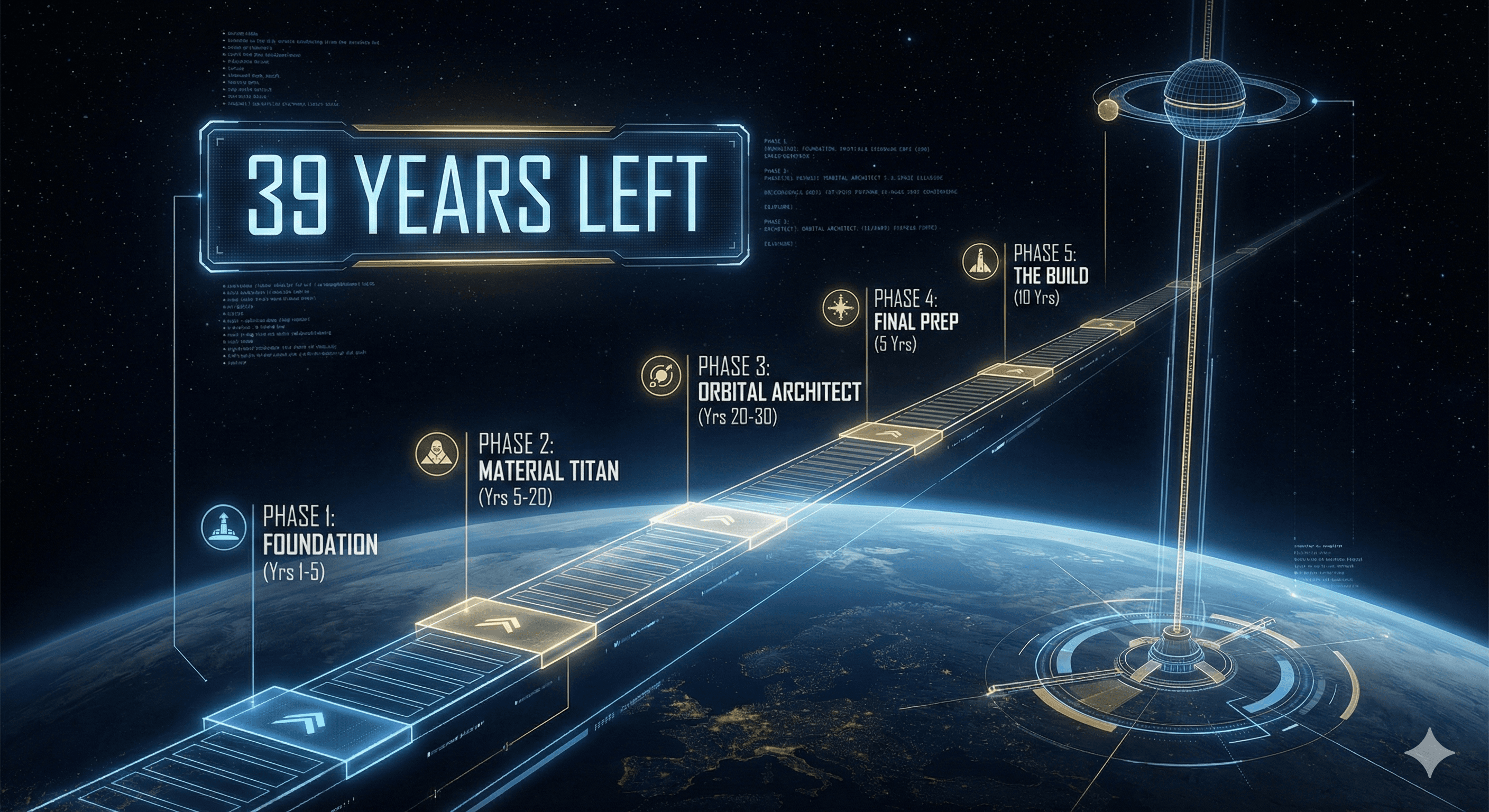
Phase 1: (Years 1–5) This is where we are right now. The first five years are about building the engine that drives the company. We are establishing the brand, building the marketing platform, and finalizing the technical architecture for material production. This phase is also about generating initial revenue and proving we can execute.
Phase 2: (Years 5–20) Once the foundation is set, we scale. For the next 15 years, our mission is to build a manufacturing giant in advanced materials. We need to solve the material problem at scale. This is about industrial capacity. We are building the factories and the supply chains that will produce the tether itself.
Phase 3: (Years 15–30) As our material capabilities mature, we enter the space industry. We anticipate that by this time, the broader space economy will be ready for complex operations. We will deploy in space applications and testing, using our tether technology for debris removal, satellite servicing, or lunar infrastructure.
Phase 4: (Years 25-30) Before we begin construction, we pause to ensure everything is locked in. This 5-year block is for finalizing the mission plans, securing the final capital required for the build, and ensuring all legislation and safety protocols are airtight.
Phase 5: (Years 30-40) This is the main event. A decade-long construction project where we deploy the seed tether and begin the climb. While the system won't be fully operational until the end, it will be usable throughout the process as we reinforce the ribbon. This is the final stretch to humanities’ permanent connection with the stars.
Why 39 Years?
People often ask why the timeline is so long. The truth is, we are intentionally changing the world, and we have to give the world time to handle that change.
There are two main bottlenecks that dictate this pace. First is credibility. We are building this from scratch. I am building this from scratch. We need time to build the team, the reputation, and the trust required to manage a planetary-scale infrastructure project.
Second is unfortunately, current space lead time. Until we build the elevator, we are stuck with the slow, expensive logistical realities of rockets. We have to wait for testing opportunities, launch windows, and for the space economy itself to evolve to a point where it needs what we are building.
Acceleration Factor
This is a conservative timeline. We are planning for the marathon, but we are training for the sprint.
If we can do this in half the time, we will. But the acceleration won't come just from writing a bigger check. The real speed comes from breakthroughs, in material production or robotics, and from market readiness. If the space economy explodes faster than predicted, if the demand for lunar transport or asteroid mining spikes, the timeline shifts left. 🤞
One Year Down
We are already ahead of schedule.
We have just crossed off Year 40. In that single year, we went from a plan to something tangible. We survived the zero to one phase. WSPEC was founded and launched its first competition series. We aligned a core team that is moving faster than I ever anticipated, and we secured preliminary research that puts us firmly on the technical map.
In many ways, we have done 1.5 years of work in 12 months. We are moving quickly, but the road is long.
We are now in Year 39. The clock is running. We have a lot of work to do.
Back